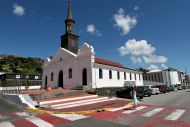
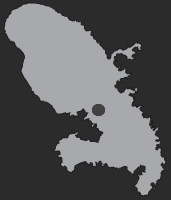
"Hardly had we landed, that we were on the Square Bertin, a true stroll planted with trees alongside the sea. Immediately, we had the sensation of being in the centre of an intense commercial city, which seemed to come from the closeness to feverish America."
(Notes from a Traveler, Le Pélerin, 20th May 1902.)
The beginning of colonization (or how the French arrived in the West Indies).
The history of Saint-Pierre is closely linked to the history of the colonization of the Martinique, and marks the beginning of the French settlement in the West Indies. A small reminder of the facts :
The XVIIth century is an unsettled period in Europe. English, Spanish, French, Flemish, Portuguese, together or against each other, fight fiercely according to coalitions. Soon, the conflict reaches the wet Indies. French and English in particular, will try to lessen the Spanish power by cutting off the maritime roads towards the rich possessions of America.
The discovery of the New World shakes the delicate European balance. Spain and Portugal grow considerably rich.
Since the discoveries of Christopher Columbus, Spain and Portugal had been sharing the riches of the New World for more than a century. Vessels full of gold and tropical products ply towards the ports of Seville and Cadix. Gold enriches the kingdom. Indigo, red brazil wood, sugar, tobacco… sell off easily to the European aristocracy and upper class… and make the fortune of the dealers. This sudden wealth of the kingdoms of Spain and Portugal shakes the political of the continent. All the more, because the French , the English and the Flemish are excluded from this juicy business. A papal bull ( the pope is no other than the former cardinal of Barcelona) and the treaty of Tordessillas (1494) forbid them all trades with the New World.
The rebellion threatens in the port of North Europe. Sailors and merchants will not be left behind.
It will not be the states of North Europe that will react first, but their fellows. From the ports of Normandy, Brittany, England and Holland, sailors and merchants organize expeditions, entirely financed by private means. Their aim : to share the trade of tropical products and eventually lay hands on the Spanish vessels.
As from 1520, filibusters and adventurers most of them French, engage in a ferocious fight on the Atlantic. Hostilities start in 1522. A filibuster from Dieppe, attacks a Spanish vessel near Azores. On ship, was the treasure of the Aztec king Moctuzema, that Cortès had intended for Charles Quint. The captures grow quickly more and more frequent and the filibusters get more emboldened Soon, they cross the Atlantic, invade the West Indies sea and more and more boats attack directly Spanish colonies. In 1537, French crews ransack several towns on the coasts of Panama and Honduras. In 1544, some other Frenchmen take Carthagène, and restore it in exchange of a heavy ransom –in silver and gold. In 1553, the corsair Jean Le Clerc, ransacks and the Canary Isles.
Towards 1550, the conflict changes. The French kingdom is directly involved, and begins a terrestrial conquest. An adventure complicated by the war of religions.
Watching the hard blows that the economy of Spain has received, the French kingdom realises what it can gain from an intensification of the battle in the West Indies sea. To help its corsairs, France tries to settle in Americas. The aim : to create fortified bases, able to serve as starting points for an attack or as withdrawal bases. That what the reason why the admiral Coligny sends a first expedition to found a fort in Brazil in 1555. (This adventure inspired the book of Christopher Ruffin : Red Brazil), and another in Florida in 1562. But these attempts failed. The Spanish forces annihilate these two starting colonies, and the French kingdom, entangled in the war of religions, soon abandons all territorial ambitions on the other side of the Atlantic, and leaves the battlefield to the new enemies of Spain. A At that time, English and French, in conflict with Spain, begin to be very interested in that part of the world.
Once France was away, the English and Flemish corsairs start fighting under the tropics. In less than 50 years, they put an end to the Spanish domination on the Atlantic. The adventure culminates with the "invincible Armada".
For several years, the English and Flemish merchants had been trying to trade with the Spanish colonies of America. But Spain refused all contact with them. Boats that are surprise trading are confiscated, and the crew imprisoned or hanged. The Queen of England gets angry : “ The use of the sea and the air is common to all and no title whatsoever can belong to a nation”. At the same time, she send her “sea-dogs” to attack the Spanish. John Hawkings ransacks the West Indies in 1565, two years later the pirate Drake takes hold of a wealthy convoy : the treasure of the Indies. Henceforth, attacks are continuous, and the Spanish power seriously threatened. By reaction, Philippe II, king of Spain, decides to invade London. 500 vessels and 100 000 men start off towards the English Channel. But this “invincible Armada” is destroyed by the English corsairs. And the few boats that escaped were destroyed by violent storms. 1588 marks the end of the Spanish domination on the Atlantic.
“In this intense commercial city that was Saint-Pierre, people could only encounter shops, offices, stores, which were perpetually overcrowded. Saint-Pierre’s stores were real bazaars where everything could be sold, from the most usual items or the most basic consumer goods to the much sought-after luxury objects… It was there where the entirely island went to get fresh supplies.
Saint-Pierre was, as regards with progress, very well-equipped and had no cause to be jealous of the big modern cities. Stores and private houses were lighted by electricity and were fitted with telephones; water was abundantly running, and a little tramway had been set up to serve the remote districts from the town.
An important part of Saint-Pierre was taken by big rum distilleries. I visited some of them. They were huge installations made of sophisticated mechanical equipment which were capable of the best outputs.”
Newspaper "Le Pélerin" Mai 1902.
Local Dances of Saint-Pierre :
“At Saint-Pierre, local dances began as soon as the ascetic feasts of the Lent were ending. From Easter Sunday, dance halls were opening. Clarinets and trombones were letting out everywhere their clear and joyful notes. They invited people from Saint-Pierre to forget their little troubles in the temples of Terpsichore. They were absolutely crazy about dance, my dear compatriots! It’s why there were numerous establishments where people could mess around the Saturday from 9 P.M. to 5 P.M.”
Salvina, “Saint-Pierre : the tropical Venice (1870-1902).